How to get around Brussels: your complete guide to urban mobility
Brussels, a European capital with a cosmopolitan charm, offers a multitude of options to easily move from one neighborhood to another. Whether you are a new resident, an international student, a professional on the move or a simple visitor curious to discover the city, understanding the Brussels transport network will allow you to save precious time and enjoy a smooth urban experience. In this practical guide, we guide you through all the mobility solutions available in the Belgian capital, from public transport to sustainable alternatives, including the most comfortable options for your important trips.
Public transport: the backbone of mobility in Brussels
The Brussels public transport network, managed by STIB (Société des Transports Intercommunaux de Bruxelles), is the most economical and often the fastest solution to cross the city. With its 4 metro lines, 18 tram lines and nearly 50 bus lines, the network covers the entire Brussels Capital Region and even serves some peripheral municipalities.
The Brussels metro
The subway is the fastest option for North-South and East-West trips. The four existing lines (lines 1, 2, 5 and 6) serve the main centres of activity in the capital. The frequency of passages is particularly high during peak hours, with a subway every 3 to 6 minutes depending on the lines. During off-peak hours and on weekends, you can count on a pass every 8 to 12 minutes.
The stations are generally well maintained and most have elevators, making it easy for people with reduced mobility as well as travelers with luggage or strollers to access them. The STIB application shows you in real time which stations are equipped with functional elevators, valuable information for planning your trips.
Trams and buses: the complete network of the city
Tram lines cover Brussels on the surface and offer the advantage of discovering the city while traveling. Some historic lines, such as tram 44 to Tervuren or tram 81, pass through particularly picturesque neighborhoods. Buses complete the network by serving areas not covered by the metro and tram, especially in residential areas and the heights of the city.
The Noctis service ensures the continuity of public service during the night with 11 bus lines that operate on Friday and Saturday evenings from midnight. These night buses all leave from Place De Brouckère and travel to the various municipalities of Brussels, with a passage every 30 minutes until around 3 am in the morning.
Prices and subscriptions: understanding the ticketing system
STIB offers a complete range of transport tickets adapted to different user profiles. The simple ticket, called Jump, costs 2.60 euros when purchased via the STIB app or at the vending machines, and allows you to travel for 60 minutes with unlimited connections. This same ticket costs 3 euros if you buy it directly from the driver, which is why it is useful to anticipate your purchases.
For stays of several days, the Jump 24h (8 euros), 48 hours (14 euros) or 72 hours (18 euros) card represents an economical option. These maps offer unlimited access to the network for the length of time chosen and are the ideal choice for tourists who want to explore the city extensively.
Residents and people working regularly in Brussels will find the monthly MOBIB subscription (49 euros) or annual subscription (499 euros) a particularly advantageous solution. The MOBIB card itself costs 5 euros and can be recharged as many times as needed. Young people under 25, seniors over 65 and people with certain social statuses can take advantage of very attractive preferential rates.
Contactless pricing via your smartphone or bank card is now possible across the entire network, considerably simplifying access to transport for occasional visitors.
Green taxis: your partner for comfortable and reliable travel
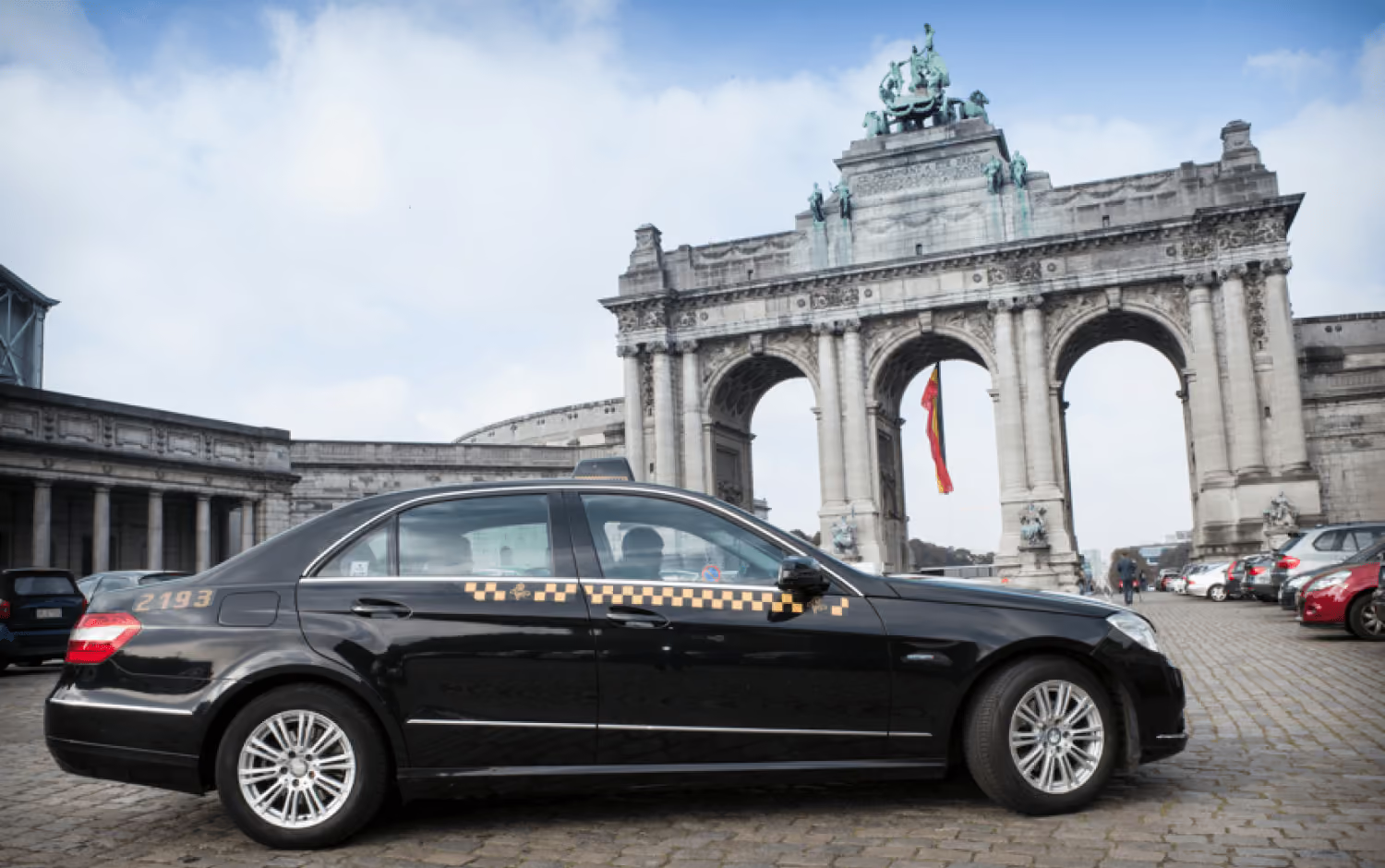
When you need absolute punctuality, superior comfort, or are carrying bulky luggage, taxi services become the obvious solution. Taxisverts is positioned as your privileged ally for all your trips in the capital and beyond.
Why choose Taxisverts for your Brussels trips
In a city where the transport offer is abundant, Taxisverts stands out for its commitment to quality of service and customer satisfaction. Our professional drivers know Brussels like the back of their hand and guarantee you an optimal journey, avoiding traffic jams thanks to their in-depth knowledge of alternative routes.
Unlike public transport where you have to deal with schedules and connections, a Taxisverts taxi offers you total flexibility. You leave whenever you want, from the exact place where you are, to arrive directly at your destination without unnecessary detours. This convenience comes into its own during important meetings, medical appointments, or when traveling with young children.
Services adapted to each need
Taxisverts offers a range of services designed to meet all situations. Our early booking service allows you to plan your important trips with complete peace of mind. Do you have an early morning flight or a late arrival at the airport? Book your taxi in advance and benefit from the guarantee that a driver will be waiting for you at the agreed time.
For trips to or from Brussels Zaventem airport, our drivers follow your flight in real time and automatically adjust their arrival in case of delay, thus avoiding unnecessary stress. The journey between the airport and the city center generally takes between 20 and 40 minutes depending on traffic, and our transparent rates are communicated as soon as you book.
Groups and families will particularly appreciate our spacious vehicles that can accommodate up to 7 passengers with their luggage. For business trips, our high-end vehicles and our simplified billing service make it easy to manage your expense reports.
Booking with Taxisverts: simple and intuitive
Our reservation system was designed for your convenience. Whether you prefer to call our 24/7 central office, use our intuitive mobile application or book via our website, the process remains simple and fast. In a few clicks, you can plan your trip, choose your type of vehicle and even specify specific requests such as a booster seat or a vehicle accessible to people with reduced mobility.
Payment is flexible: cash, bank card, mobile payment or billing for businesses. You will always receive a detailed receipt that is practical for your administrative or professional procedures.
Soft mobility: pedaling towards a greener Brussels
Brussels invests heavily in cycling infrastructure, with more than 350 kilometers of bike paths developed and new protected routes created each year. Biking is gradually becoming a credible alternative to the car, especially for local trips.
Villo: the shared bike system in Brussels
The Villo service offers 5,000 bikes spread over 360 stations throughout the Brussels Region. The principle is simple: you unlock a bike at any station and drop it off at the station of your choice once you arrive at your destination. The annual subscription costs 33 euros and the first 30 minutes of each trip are free, which covers the majority of urban trips.
For occasional users, subscriptions for the day (1.73 euros) or for the week (5.20 euros) also exist. The Villo app allows you to locate available stations, check the number of bikes present and even reserve a bike for a few minutes.
Electric bikes are also multiplying in the fleet, making the Brussels coastline less intimidating. These electric bikes greatly facilitate travel in hilly neighborhoods such as Uccle, Ixelles or Forest.
Other shared mobility solutions
Beyond Villo, many private operators offer electric scooters, electric bikes and shared scooters. The Lime, Dott, Tier and other applications allow you to unlock these devices in a few seconds. Rates generally include an unlocking cost (around 1 euro) plus a rate per minute (between 0.15 and 0.25 euros).
This diversity of options favors a multimodal approach where you can combine several means of transport according to your needs. For example, taking the subway to cross the city and then finishing your trip on an electric scooter is often the winning combination to combine speed and flexibility.
Essential applications to optimize your trips
Digital transformation has considerably simplified the mobility experience in Brussels. Several applications are particularly useful for planning and optimizing your daily trips.
The STIB app: your public transport companion
The official STIB application has become essential for any regular user of public transport in Brussels. It offers multimodal routes in real time, alerts you to network disturbances, displays the next passages at your stop and even allows you to buy your tickets directly from your smartphone.
The “favorites” tab allows you to save your usual trips and instantly consult the schedules without having to re-enter your itinerary each time. Especially practical on busy mornings where every minute counts.
Floya: the global vision of your mobility
Floya represents the reference application for a complete multimodal approach. It aggregates all the available transport options: public transport, shared bikes, scooters, taxis, shared car services and even available car parks. By simply entering your destination, Floya offers you several routes combining different modes of transport with an estimate of the time and cost for each option.
This comparative vision allows you to make informed decisions according to your current priorities: prioritize speed, minimize the cost or choose the most ecological option.
Complementary applications
For parking, the 4411 application simplifies the payment of your street parking and sends you a notification before your paid time expires. No more running to the parking meter with change.
Bicycle users will love Cyclofix, which lists Villo stations, secure bike parks, and even nearby repair shops. The application also indicates bike paths and suggests routes adapted to cyclists, avoiding busy roads as much as possible.