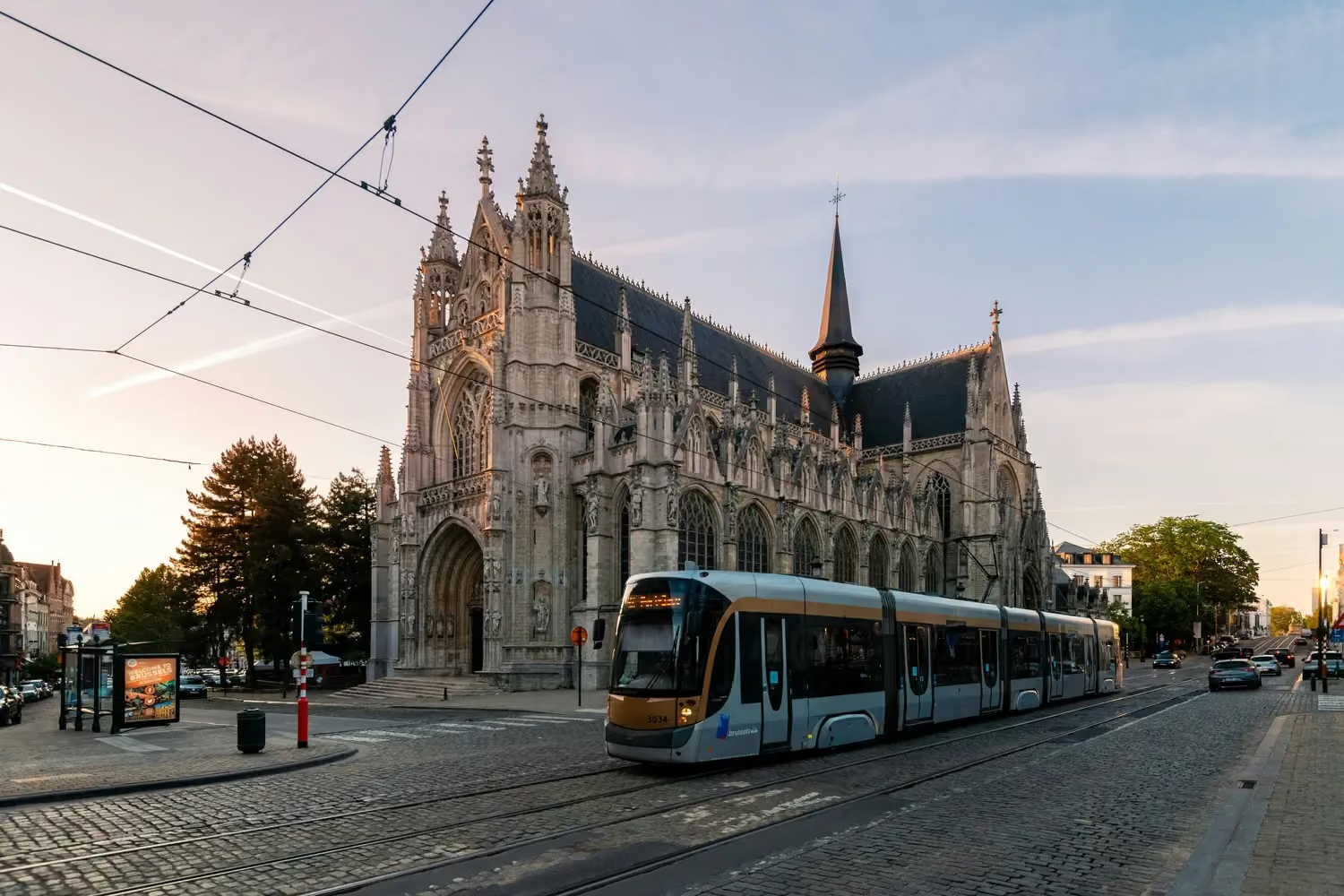
Getting around Brussels requires a good understanding of the various options available. Between public transport, taxis, soft mobility and shared services, the Belgian capital offers a range of solutions adapted to each situation. This guide helps you navigate this diverse ecosystem to choose the best option for your needs, whether you are a resident, a traveling professional, or a visitor.
Overview of transport solutions in Brussels
Public transport, a dense network but there is room for improvement
STIB manages the metro, tram and bus network that covers the entire region. The metro operates from 5:30 a.m. to around midnight, with four main lines that serve strategic axes. Trams and buses complete this network, which are particularly useful in less central neighborhoods.
However, the reality on the ground presents some challenges. Delays are common during peak hours, vehicle cleanliness sometimes leaves something to be desired, and some areas remain poorly served in the evening. Network density in the center contrasts with more random coverage at the periphery.
Intermodality with SNCB trains via the main stations (Midi, Central, North) works well in theory, but connections can be complicated for those who are not fully familiar with the system.
Taxis, flexibility and reliability for your priority trips
Faced with the constraints of public transport, taxis represent a particularly relevant alternative for many situations. Business meetings with tight deadlines, night trips, trips with luggage or bulky equipment, trips to the airport: so many cases where the reliability and comfort of a taxi make the difference.
Modern taxi services have evolved considerably. Booking via app allows you to order a vehicle in a few clicks, with a transparent price estimate before the race. Real-time monitoring of the driver's arrival eliminates uncertainty, which is particularly valuable during important trips.
For businesses, business accounts simplify the management of employee travel with centralized billing and detailed reporting. This solution is often more economical than one might think, especially when accounting for the time saved and the productivity maintained.
Understand pricing and payment options
Public transport, a complex pricing system
The STIB single ticket costs 2.60 euros if purchased in advance, 3 euros on board. The monthly subscription at 54 euros is suitable for very regular users, but represents a significant investment if you do not use it daily.
The MOBIB card, an electronic medium that is mandatory for most formulas, requires an initial purchase of 5 euros and must be recharged at specific points of sale. The system may seem unintuitive for newcomers or casual visitors.
The Brupass combines STIB, De Lijn and TEC for commuters crossing regional borders. Practical on paper, but its cost varies greatly depending on the areas concerned, making comparison with other transport solutions less obvious.
Taxi services, transparency and adapted options
The pricing of taxis in Brussels generally works with a charge of around 2.40 euros and then around 1.80 euros per kilometer during the day. Booking applications always show an estimate before validation, eliminating unpleasant surprises.
This transparency is a major advantage, especially for recurring trips where you know the cost in advance. Secure electronic payments, automatic invoices, and business account options also facilitate administrative management.
For regular trips, some providers offer preferential rates or adapted packages, which are particularly interesting for trips between home and work or frequent business trips.
Applications and tools to optimize your trips
The Taxisverts application, your essential mobility ally
To simplify your taxi trips in Brussels, the Taxisverts application is the reference solution. Its intuitive interface makes it possible to order a vehicle in a few seconds, with precise geolocation that avoids any confusion at the pick-up point.
The application displays a clear price estimate before confirming the race, allowing you to budget your trips transparently. Real-time vehicle tracking tells you exactly when your driver will arrive, eliminating waiting in uncertainty.
Taxisverts also offers features that are particularly appreciated by professionals: programming trips in advance for your morning appointments or airport trips, detailed history of trips to manage your expense reports, and secure payment directly via the application. For businesses, professional accounts centralize billing and offer optimal control over employee travel.
The fleet, committed to an ecological approach with hybrid and electric vehicles, meets environmental concerns while guaranteeing the comfort and reliability expected from a professional taxi service.
Complementary multimodal planning
Google Maps is still a useful tool for quickly comparing all the available options. The application simultaneously calculates travel times by public transport, taxi, bicycle or on foot, allowing you to choose according to your current priorities.
The STIB application focuses only on the public network with route calculation and mobile ticket purchase. Useful if you use this mode exclusively, but less relevant for a global vision of your travel options.
The ideal is to combine these different tools according to your needs: Taxisverts for your taxi trips with all the dedicated functionalities, Google Maps for an overview of the options, and the STIB application if you use public transport occasionally.
Real-time comparison for informed decisions
True intelligence consists in comparing in real time according to your specific situation. A trip that takes 15 minutes on an off-peak subway can easily reach 30 minutes with connections and waiting times during rush hour, where a taxi maintains a more predictable schedule.
With the Taxisverts application, this comparison becomes immediate: you see the estimated time and the approximate price, allowing you to make an informed decision in a few seconds depending on the urgency of your trip.